Felix Menne, Felix Dörr, Johannes Tröger, Alexandra König, Diana Immel, Simon Barton, René Hurlemann
*Poster presented at ISCTM Autumn Meeting 2025
The Methodological Issue Being Addressed
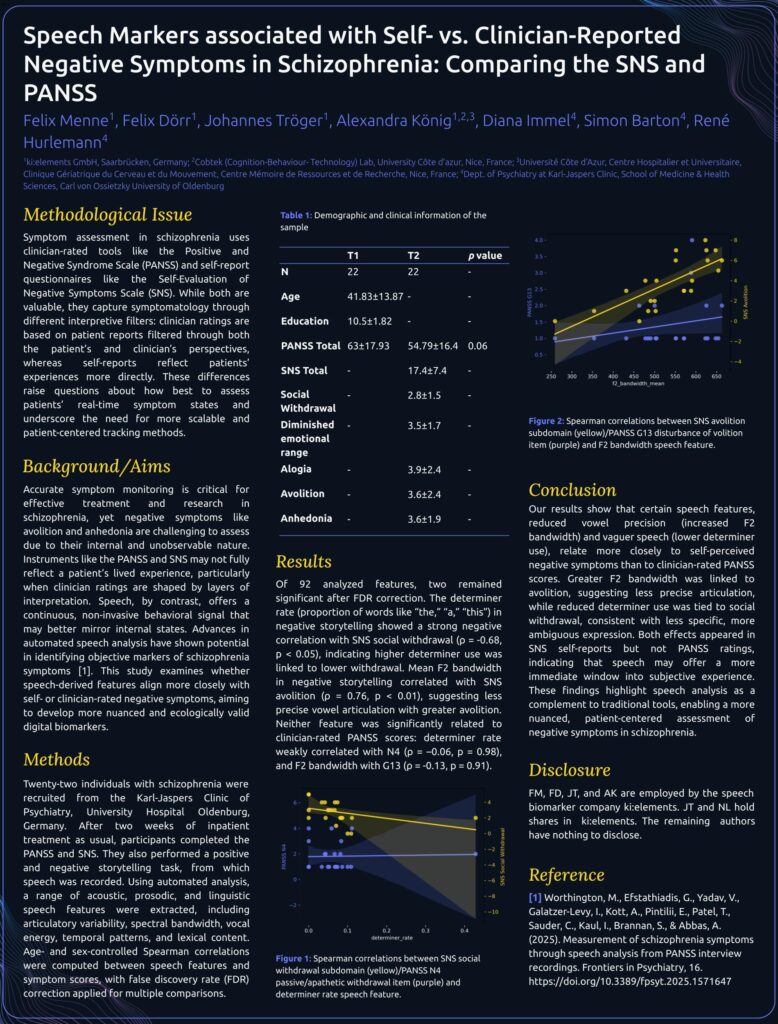
Symptom assessment in schizophrenia uses clinician-rated tools like the Positive and Negative Syndrome Scale (PANSS) and self-report questionnaires like the Self-Evaluation of Negative Symptoms Scale (SNS). While both are valuable, they capture symptomatology through different interpretive filters: clinician ratings are based on patient reports filtered through both the patient’s and clinician’s perspectives, whereas self-reports reflect patients’ experiences more directly. These differences raise questions about how best to assess patients’ real-time symptom states and underscore the need for more scalable and patient-centered tracking methods.
Introduction / Aims
Accurate symptom monitoring is critical for effective treatment and research in schizophrenia, yet negative symptoms like avolition and anhedonia are challenging to assess due to their internal and unobservable nature. Instruments like the PANSS and SNS may not fully reflect a patient’s lived experience, particularly when clinician ratings are shaped by layers of interpretation. Speech, by contrast, offers a continuous, non-invasive behavioral signal that may better mirror internal states. Advances in automated speech analysis have shown potential in identifying objective markers of schizophrenia symptoms (Worthington et al., 2025). This study examines whether speech-derived features align more closely with self- or clinician-rated negative symptoms, aiming to develop more nuanced and ecologically valid digital biomarkers.
Methods
Twenty-two individuals with schizophrenia were recruited from the Karl-Jaspers Clinic of Psychiatry, University Hospital Oldenburg, Germany. After two weeks of inpatient treatment as usual, participants completed the PANSS and SNS. They also performed a positive and negative storytelling task, from which speech was recorded. Using automated analysis, a range of acoustic, prosodic, and linguistic speech features were extracted, including articulatory variability, spectral bandwidth, vocal energy, temporal patterns, and lexical content. Age- and sex-controlled Spearman correlations were computed between speech features and symptom scores, with false discovery rate (FDR) correction applied for multiple comparisons.
Results
Of 92 analyzed features, two remained significant after FDR correction. F1 relative energy variability from positive storytelling showed a strong negative correlation with SNS total score (ρ = –0.76, p = 0.01), indicating reduced vocal energy variability among those with higher self-rated negative symptoms. Mean F2 bandwidth from negative storytelling was negatively correlated with the SNS avolition subscore (ρ = –0.76, p < 0.01), suggesting reduced articulatory precision with increased avolition. Neither feature was significantly associated with clinician-rated PANSS scores: F1 relative energy variability weakly correlated with PANSS negative items (ρ = –0.11, p = 0.99); F2 bandwidth with item G13 (ρ = -0.13, p = 0.91).
Conclusions
These results suggest that articulatory speech features, especially reduced vocal energy variability and narrowed formant bandwidths, are more strongly linked to self-perceived negative symptoms, particularly avolition, than to clinician-rated PANSS measures. This may reflect the SNS’s greater sensitivity to subjective motivational and experiential deficits, while clinician ratings are shaped by interpretive layers, potentially obscuring subtle internal states. Speech may offer a more immediate and continuous reflection of internal experience, aligning better with self-reports. These findings support speech data to complement traditional tools and offer a more nuanced, patient-centered assessment of negative symptoms in schizophrenia.