Felix Menne, Felix Dörr, Johannes Tröger, Alexandra König, Diana Immel, Simon Barton, René Hurlemann
Poster Presentation at American College of Neuropsychopharmacology (ACNP) 2026
Background: Cognitive impairment is a core and enduring feature of numerous psychiatric disorders, notably schizophrenia (SZ) and major depressive disorder (MDD). Deficits in verbal memory, processing speed, and executive functioning may persist independently of acute symptoms and strongly predict functional outcomes. Despite their relevance, cognitive assessments are rarely implemented in routine psychiatric care due to constraints in time, cost, and ecological validity.
In neurodegenerative disorders like Alzheimer’s disease, adding automated speech analysis to cognitive tasks has improved the sensitivity of traditional cognitive assessments in their ability to detect the disease and predict cognitive decline [1]. Preliminary evidence suggests this approach may also be applicable in psychiatric disorders. Building on this, this study explores the potential added value of speech analysis in enhancing cognitive assessment in individuals with SZ, MDD, and healthy controls (HC), with the goal of furthering the development of digital biomarkers for psychiatry.
Methods: Participants with SZ, MDD, and HC were recruited from the Department of Psychiatry, Karl Jaspers Clinic, University of Oldenburg, Germany. Diagnoses followed DSM-5; symptom severity was assessed with the PANSS (SZ) and MADRS (MDD).
All participants completed smartphone-based versions of the Rey Auditory Verbal Learning Test (RAVLT; 4 trials, 15 words each, no delayed recall) and the Semantic Verbal Fluency test (SVF; animal naming, 60 s). Verbal responses were automatically transcribed and analyzed using natural language processing to generate 70 features capturing semantic, temporal, and task-specific speech characteristics (e.g., learning slopes). These informed subdomain scores for memory, executive function, and processing speed, plus a composite cognitive score (SB-C). All scores were adjusted for age, sex, and education using a normative sample.
Group comparisons between composite and subdomain scores were computed with Kruskal-Wallis tests.
For classification, Support Vector Machines (SVM), Random Forests (RF), Linear Models (LM), and other classifiers were trained to distinguish diagnostic groups using (1) raw RAVLT and SVF scores and (2) these scores plus speech-derived features. Performance was evaluated with 10-fold cross-validation and AUC; best-performing models are reported. Permutation feature importance identified the most informative features.
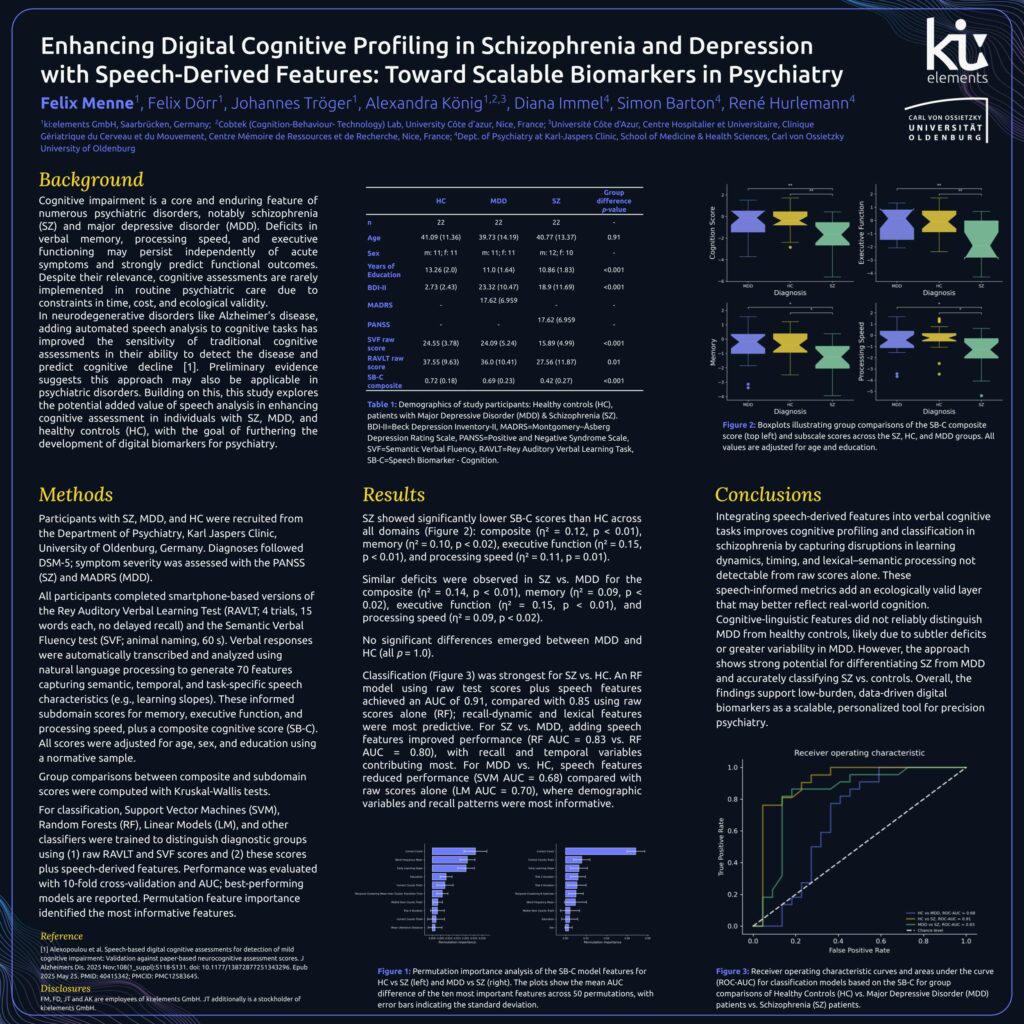
Results: SZ showed significantly lower SB-C scores than HC across all domains (Figure 2): composite (η² = 0.12, p < 0.01), memory (η² = 0.10, p < 0.02), executive function (η² = 0.15, p < 0.01), and processing speed (η² = 0.11, p = 0.01).
Similar deficits were observed in SZ vs. MDD for the composite (η² = 0.14, p < 0.01), memory (η² = 0.09, p < 0.02), executive function (η² = 0.15, p < 0.01), and processing speed (η² = 0.09, p < 0.02).
No significant differences emerged between MDD and HC (all p = 1.0).
Classification (Figure 3) was strongest for SZ vs. HC. An RF model using raw test scores plus speech features achieved an AUC of 0.91, compared with 0.85 using raw scores alone (RF); recall-dynamic and lexical features were most predictive. For SZ vs. MDD, adding speech features improved performance (RF AUC = 0.83 vs. RF AUC = 0.80), with recall and temporal variables contributing most. For MDD vs. HC, speech features reduced performance (SVM AUC = 0.68) compared with raw scores alone (LM AUC = 0.70), where demographic variables and recall patterns were most informative.
Conclusions: Integrating speech-derived features into verbal cognitive tasks improves cognitive profiling and classification in schizophrenia by capturing disruptions in learning dynamics, timing, and lexical–semantic processing not detectable from raw scores alone. These speech-informed metrics add an ecologically valid layer that may better reflect real-world cognition. Cognitive-linguistic features did not reliably distinguish MDD from healthy controls, likely due to subtler deficits or greater variability in MDD. However, the approach shows strong potential for differentiating SZ from MDD and accurately classifying SZ vs. controls. Overall, the findings support low-burden, data-driven digital biomarkers as a scalable, personalized tool for precision psychiatry.