Clàudia Porta-Mas, Andreea Rădoi, Alexandra König, Elisa Malick, Johannes Tröger, Oriol Grau-Rivera, Gemma Salvadó, Gonzalo Sánchez-Benavides
*Poster presented at AAIC 2026
Background
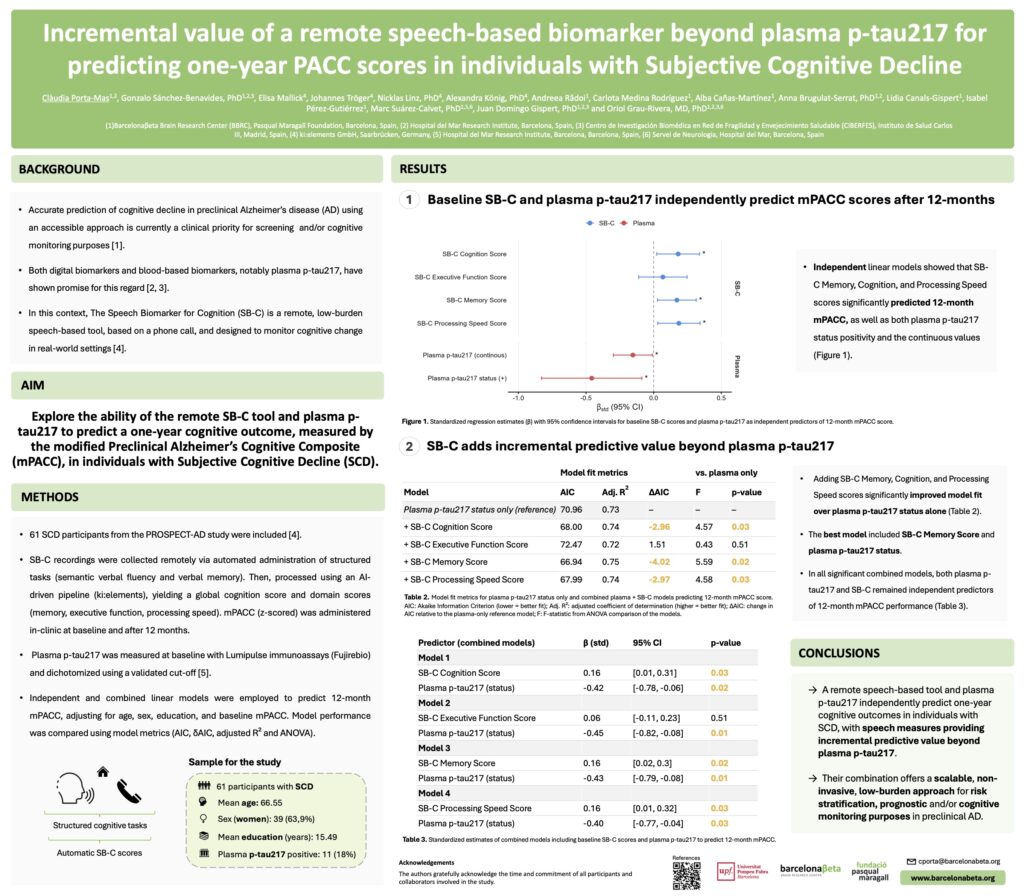
Accurate prediction of cognitive decline in preclinical Alzheimer’s disease (AD) using an accessible approach is a clinical priority. Both digital biomarkers and blood-based biomarkers have shown promise in this context. The Speech Biomarker for Cognition (SB-C) is a remote, speech-based tool designed to monitor cognitive change in naturalistic settings. In this study, we compared the ability of SB-C and plasma p-tau217 to predict one-year cognitive outcomes, measured by the Preclinical Alzheimer’s Cognitive Composite (PACC), in individuals with Subjective Cognitive Decline (SCD).
Methods
65 participants with SCD were included (Table 1). SB-C recordings were collected remotely using structured cognitive tasks (semantic verbal fluency and verbal memory). Speech data were processed using an AI-driven pipeline developed by ki:elements, yielding composite cognition scores and domain-specific scores (memory, executive function, and processing speed). PACC was administered in-clinic at baseline and 12 months. Plasma p-tau217 was measured at baseline and dichotomized using a validated cut-off (positive/negative); continuous p-tau217 values were analyzed after log10 transformation. Linear regression models predicted 12-month PACC, adjusting for age, sex, education, and baseline PACC. Model performance was compared using adjusted R².
Results
SB-C cognition score significantly predicted 12-month PACC (βSTD=0.20;p=0.008). Among SB-C domains, SB-C executive function score (βSTD=0.16;p=0.042), and SB-C processing speed score (βSTD=0.12;p=0.02) were also significant predictors, with SB-C memory score showing a trend (βSTD=0.17;p=0.07). Positive plasma p-tau217 status predicted worse 12-month PACC (βSTD=-0.15;p=0.023), and continuous log10-transformed p-tau217 levels were similarly associated with poorer outcomes (βSTD=-0.13;p=0.043) (Figure 1).
In combined models, SB-C cognition score (βSTD=0.18;p=0.019) and plasma p-tau217 status (βSTD=-0.13;p=0.049) remained significant independent predictors. A combined model including SB-C cognition score significantly improved prediction of one-year PACC compared with plasma p-tau217 status alone (adjusted R²=0.765 vs 0.746;ΔF=5.83;p=0.018). Similarly, a combined model including SB-C processing speed score (βSTD=0.15;p=0.036) and plasma p-tau217 status (βSTD=-0.14;p=0.034) improved model fit relative to the plasma p-tau217 status alone (adjusted R²=0.760 vs 0.746;ΔF=4.60;p=0.036) (Table 3).
Conclusion
Remote speech-based biomarkers and plasma p-tau217 independently predict one-year cognitive outcomes in SCD, with SB-C providing incremental value beyond plasma p-tau217. Their combination offers a scalable, low-burden approach for early risk stratification and cognitive monitoring in preclinical AD.