Johannes Tröger, Ema Josipovic, Felix Dörr, Johan Skoog, Fredrik Öhman, Nicklas Linz, Alexandra König, Michael Schöll, Silke Kern, Ingmar Skoog
*Poster presented at AD/PD 2026
Introduction: The research aimed to evaluate the clinical utility of a remote, speech-based digital cognitive assessment for monitoring cognitive progression in preclinical and prodromal Alzheimer’s disease. Specifically, we investigated whether the automatically derived ki:elements Speech Biomarker for Cognition (SB-C) could sensitively detect cognitive decline and predict future clinical status in the context of a real world epidemiological cohort.
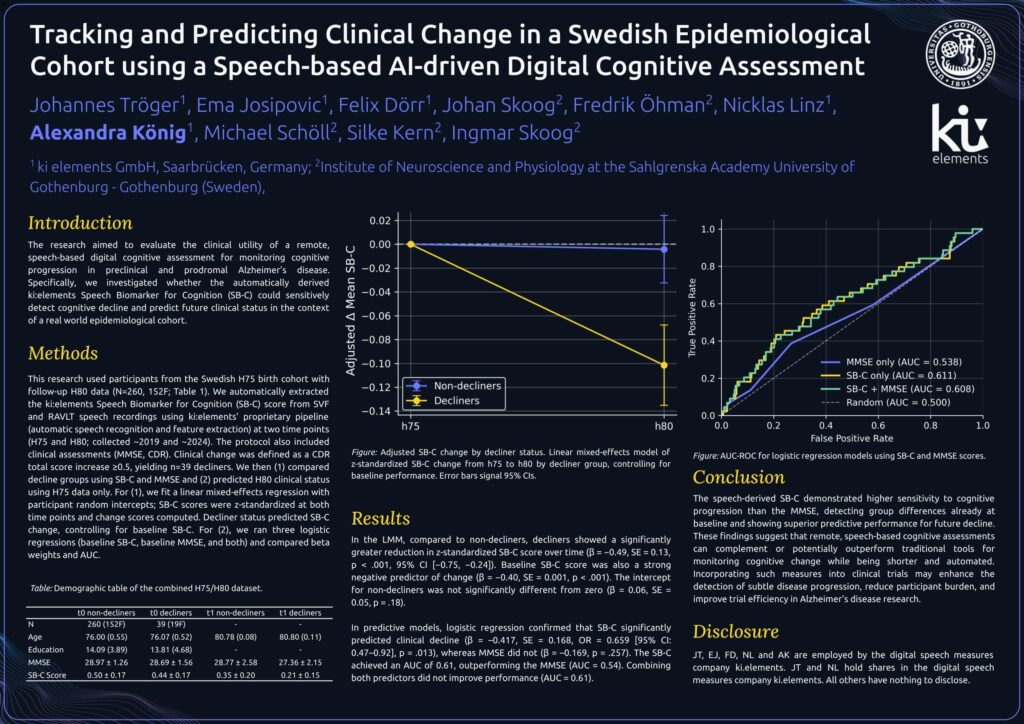
Methods: This research used participants from the Swedish H75 birth cohort with follow-up H80 data (N=260, 152F; Table 1). We automatically extracted the ki:elements Speech Biomarker for Cognition (SB-C) score from SVF and RAVLT speech recordings using ki:elements’ proprietary pipeline (automatic speech recognition and feature extraction) at two time points (H75 and H80; collected ~2019 and ~2024). The protocol also included clinical assessments (MMSE, CDR). Clinical change was defined as a CDR total score increase ≥0.5, yielding n=39 decliners. We then (1) compared decline groups using SB-C and MMSE and (2) predicted H80 clinical status using H75 data only. For (1), we fit a linear mixed-effects regression with participant random intercepts; SB-C scores were z-standardized at both time points and change scores computed. Decliner status predicted SB-C change, controlling for baseline SB-C. For (2), we ran three logistic regressions (baseline SB-C, baseline MMSE, and both) and compared beta weights and AUC.
Results: In the LMM, compared to non-decliners, decliners showed a significantly greater reduction in z-standardized SB-C score over time (β = −0.49, SE = 0.13, p < .001, 95% CI [−0.75, −0.24]). Baseline SB-C score was also a strong negative predictor of change (β = −0.40, SE = 0.001, p < .001). The intercept for non-decliners was not significantly different from zero (β = 0.06, SE = 0.05, p = .18).
In predictive models, logistic regression confirmed that SB-C significantly predicted clinical decline (β = –0.417, SE = 0.168, OR = 0.659 [95% CI: 0.47–0.92], p = .013), whereas MMSE did not (β = –0.169, p = .257). The SB-C achieved an AUC of 0.61, outperforming the MMSE (AUC = 0.54). Combining both predictors did not improve performance (AUC = 0.61).
Conclusion: The speech-derived SB-C demonstrated higher sensitivity to cognitive progression than the MMSE, detecting group differences already at baseline and showing superior predictive performance for future decline. These findings suggest that remote, speech-based cognitive assessments can complement or potentially outperform traditional tools for monitoring cognitive change while being shorter and automated. Incorporating such measures into clinical trials may enhance the detection of subtle disease progression, reduce participant burden, and improve trial efficiency in Alzheimer’s disease research.